

Choosing the right solar battery size has become one of the most important decisions Australian homeowners face when upgrading their energy setup. With electricity prices continuing to rise and grid reliability becoming less predictable, batteries are no longer a “nice to have”. But bigger does not automatically mean better.
Many households overspend on battery capacity they never fully use. Others undersize their system and remain dependent on the grid during the most expensive hours of the day. This guide cuts through the confusion and helps you understand how to choose a battery size that actually fits how your home uses energy.
This guide is not about brands or sales tactics. It is a practical sizing guide based on real household behaviour, Australian conditions, and how batteries actually work day to day.
Who This Guide is for?This solar battery guide is designed for Australian homeowners who want clear, unbiased advice before making a major energy decision, including:
- Homes that already have rooftop solar and are considering adding a battery
- Families planning a new solar and battery installation together
- Households running common system sizes such as 6.6kW, 10kW, or 13kW
- People concerned about power bills, blackouts, or long-term energy independence
- Anyone who wants realistic sizing guidance, not sales-driven recommendations
If your goal is to make your solar work harder for your household, battery size matters more than most people realize.
Why Solar Panel Battery Size Matters More Than You Think?
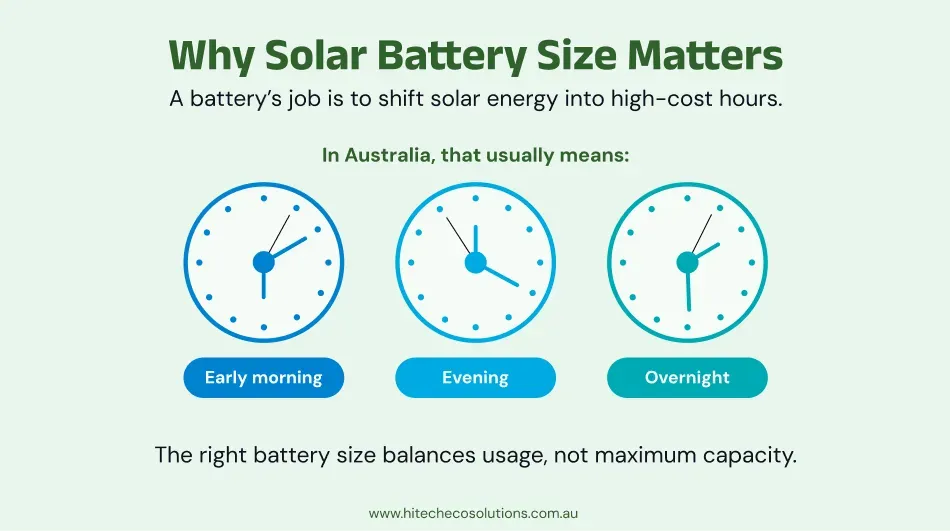
The purpose of a battery is not to store as much energy as possible. Its real job is to shift your solar energy into the hours when electricity is most expensive and the grid is under the most strain.
In Australia, that usually means:
- Early morning
- Evening
- Overnight
If your battery is too large, much of its capacity may sit unused. If it is too small, you will still rely heavily on grid power during peak times. Getting the balance right is the key to long-term value.
A Simple Rule of Thumb for Solar Battery Sizing
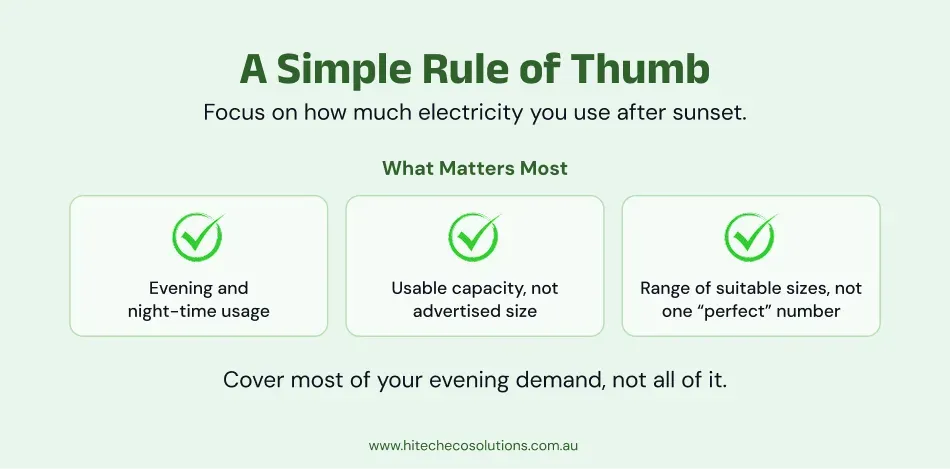
As a starting point for most Australian homes:
- Focus on how much electricity you use after sunset, not total daily usage
- Most households fall into a usable battery range rather than a single “perfect” size
- Evening and night-time consumption matters far more than daytime use
For many families, the right solar battery size is one that covers most of their evening demand, not all of it. This approach usually delivers better value than trying to power the entire house overnight.
How to Calculate the Right Solar Panel Battery Size for Your Home?
There are three core factors that matter more than anything else.
1. Your Evening Electricity Usage
Check your electricity bill or smart meter data and look specifically at usage between late afternoon and early morning. This is the energy your battery will realistically need to supply.
2. Your Primary Goal
Ask yourself what you want the battery to do:
- Reduce evening power bills
- Provide blackout protection for essentials
- Increase independence from the grid
Each goal points to a different battery sizing strategy.
3. Usable Capacity, Not Just Advertised Capacity
Not all battery capacity is usable. Efficiency losses, depth-of-discharge limits, and tariff structures all affect real-world performance. This is why a properly designed solar battery system matters just as much as battery size.
Solar Panel Battery Size Examples Based on Common System Sizes
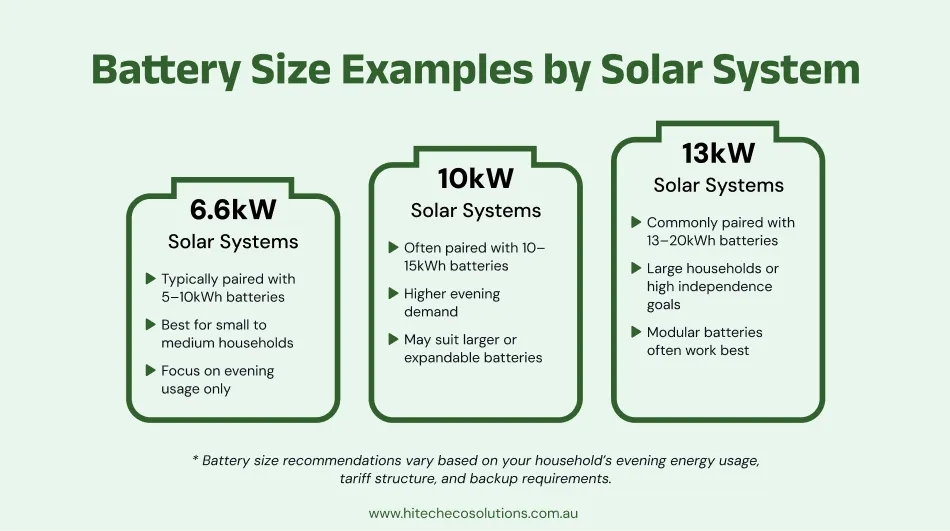
Solar Battery for a 6.6kW Solar System
6.6kW: Commonly paired with 5–10kWh batteries
This is the most common residential solar size in Australia.
- Battery sizing typically focuses on evening usage only
- Best suited to small to medium households
- Works well for families who are home mainly in the evenings
In many cases, pairing a 6.6kW system with a right-sized battery improves self-consumption without unnecessary overspend.
Solar Battery for a 10kW Solar System
10kW: Often paired with 10–15kWh batteries
Larger solar systems generate more excess energy, but that does not automatically mean you need a huge battery.
- Suitable for families with higher evening usage
- Often used in homes with electric appliances or EV charging
- May benefit from slightly larger or expandable battery setups
This is where planning for future usage becomes important.
Solar Battery for a 13kW Solar System
13kW: Commonly paired with 13–20kWh battery capacity
These systems are common in large households or homes aiming for high energy independence.
- Modular batteries often make more sense than a single large unit
- Allows capacity to grow as household needs change
- Works well for homes exporting large amounts of daytime solar
A flexible approach often delivers better long-term value than installing maximum capacity upfront.
*Battery size should always be calculated using your actual evening electricity consumption data and future energy plans.
Cheaper Home Battery Program and the 1 May 2026 Update
Federal incentives have brought batteries within reach for more households. The Cheaper Home Battery Program is designed to support adoption, not encourage waste.
What matters for sizing:
- Incentives reduce upfront cost pressure
- Policy increasingly favours right-sized, efficient systems
- Oversizing purely to chase incentives can reduce real-world returns
- The battery discount is based on usable capacity, not advertised size
- Incentives are delivered via STCs under the SRES, with stronger compliance and safety standards from 1 May 2026
Cost and Payback Considerations (Without the Hype)
Battery value depends on several variables:
- Your electricity tariff structure
- How much energy you shift off the grid
- How consistently the battery is used
For some homes, smaller batteries with high utilization outperform larger systems that sit partially unused. For others, staged upgrades provide better flexibility. There is no universal answer, only better-informed choices.
Common Mistakes Australian Homeowners Make
Many battery regrets come from the same mistakes.
- Oversizing to chase incentives rather than usage
- Ignoring real evening consumption patterns
- Choosing systems without checking inverter compatibility
- Selecting a battery based on price alone
A solar battery for house use must be matched to lifestyle, not marketing.
If you’re still unsure which battery size is right for your solar system, the team at HiTech Eco Solutions can assess your usage and help you choose a battery that actually fits your home.

FAQs
It depends on your evening usage, goals, and tariff structure, not just your solar size.
For many households, yes. For others, it may be more than needed.
Oversizing can reduce utilization and long-term value.
No. Export patterns and usage matter more.
Many modern systems are modular and expandable.
Time-of-use tariffs increase the value of correctly sized batteries.